Yoga, The Evidence
Chang Park | SEP 21, 2023
Yoga, The Evidence
Chang Park | SEP 21, 2023
Firstly, apologies; there’s no class this weekend as I’m currently galavanting around Manchester Convention Centre for a few days - totally buzzin’!
I’m teaching a spot of yoga this morning at the BSLM (British Society of Lifestyle Medicine) conference, where I’ll be attempting to increase yoga awareness and advocate for the greater integration of yoga into healthcare. Yoga in Healthcare Alliance - yours truly, representin’!
As I prepare to give a short presentation at the conference, I'm focused on capturing the interest of my fellow medical professionals when it comes to the benefits of yoga. The answer is pretty simple - evidence: reproducible, statistically significant, existing and emerging evidence.
You may already know the substantial evidence supporting yoga’s effectiveness in group exercise for conditions such as chronic non-specific back pain, which is now included in UK NICE guidelines. The positive effects of mindfulness and meditation on stress and mood have also been widely recognised. It’s hard to find a CEO, athlete, or influencer who doesn’t practice yoga or meditation nowadays. It's no longer difficult to persuade those with the means and access to yoga to give it a go.
While I’m happy to see yoga gaining popularity year after year, I’d love to see that this low-risk, non-pill intervention can benefit those who need it most, including those in my own home - patients and healthcare. To achieve this, we need high-quality evidence, and lots of it.
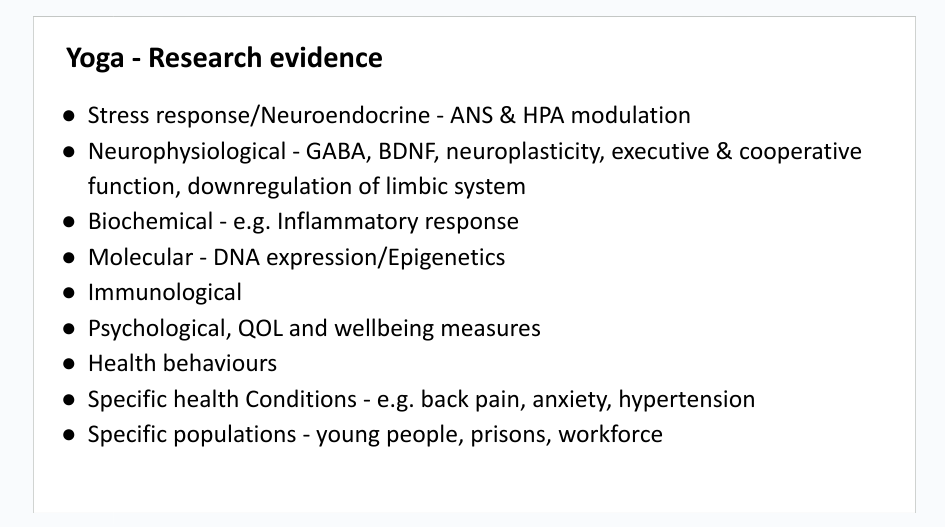
Fortunately, yoga research has been booming, particularly in the past decade, with studies covering a wide range of areas, from measuring cellular and biochemical changes to studying the impact of yoga on stress, sleep, quality of life, immune function, and gene expression. I’ve compiled a list illustrating a few areas where yoga research has been conducted, some of which I hope to impress upon my audience and demonstrate the exciting breadth of this field.
Evidence is King
You might ask why evidence is important. If you practise yoga yourself, you might not need any intellectual support for what you know to be true of your personal experience - that yoga works. But perhaps you’ve wondered why. What are the mechanisms at play?
As someone trained in scientific inquiry, it’s fascinating to me to try and figure out why exactly yoga does what it does. Why does it make me feel relaxed? How does focusing on the breath help me? Why am I less reactive? Why does it improve my sports performance or concentration? Can I explain any of this magic using scientific reasoning? Furthermore, will the existing evidence for yoga’s benefits withstand the scrutiny of my colleagues at this week’s conference?
I’m dead keen that healthcare professionals recognise the potential of yoga. To achieve this, evidence is king. The rigour of testing, analysis and peer-reviewed publication is essential to establish yoga's validity, safety, and benefits in a way that is acceptable to the medical community. I’m also well aware of the risk of personal bias influencing my thinking, so robust literature is crucial to starting and informing conversations (as well as helping to question what we think we know). Through evidence, yoga might be welcomed at the door of healthcare (and might become part of the family eventually). Now wouldn't that be mint? 😛
The exciting thing about discovering evidence is that with solid foundations built, it’s just the beginning of greater enquiry. Interesting findings from studies provoke more questions, such as how much yoga should we do, with what frequency, and what style? How much more asana v breathing v meditation? Does the group setting make a difference, does the teacher? Does online guidance do as much as in-person? And does it need to be personalised and tailored according to condition, age, need, in what dose, and by whom? I have my own ideas about the answers to these questions, but in time, evidence may help us find the best way for students, teachers, patients and society.
Did you know...
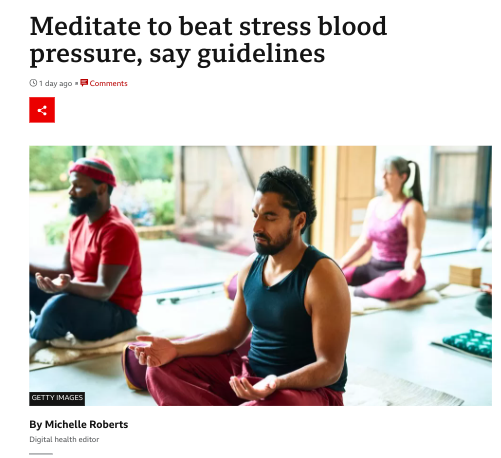
Only this week, the BBC News App reported that expert guidance from the International Society of Hypertension now recommends ‘body and mind’ practices like meditation to lower stress-related blood pressure. One of the authors of the position paper published in the Journal of Hypertension says there is ‘enough scientific evidence for some less conventional approaches.’
Prof Williams said (quote), “It all sounds a bit soft and fluffy and not as dynamic..as taking drugs, but these things make such an important contribution...” He acknowledged that the evidence is growing, but I’d argue with him that I wouldn’t consider this a ‘soft and fluffy’ intervention by any means if you can demonstrate consistent results comparable to a drug.
More than Evidence
Yoga - you all know I’m mad fer it (how many more Manchesterisms do you reckon I fit into this blog?)
While evidence can be helpful, if not absolutely necessary, to convince others, I no longer require it to inform my personal practice. I believe that the true essence of yoga goes beyond what can be proven by evidence. Evidence may be king for some, but it’s not everything. And just as the vastness of human experience cannot be fully measured, the positive impact of yoga cannot be fully gauged in words or numbers. It must be experienced to truly understand its benefits.
Hence, your kid (temporarily) in the North be bringing both to the table this conference week - experience and evidence.
Wish me luck! And see you back on the mat next week.
Chang Park | SEP 21, 2023
Share this blog post
 OfferingTree