Yoga Hurts
Chang Park | NOV 17, 2023
Yoga Hurts
Chang Park | NOV 17, 2023
Once, I Did A Lot of Yoga
This week, I’ve been experiencing a twingey pain in my lower back that sometimes arises. The most probable cause for this discomfort is overdoing it during my recent yoga retreat.
I can recall a few years ago, during my yoga teacher training, when I first experienced this kind of back pain. I did a lot of yoga at the time, taking multiple classes a week - sometimes even several in a day. I was eager to learn and improve but pushed myself obsessively, even when I was tired. I tried to figure out what was causing the pain, whether it was an alignment issue, asymmetry, or something else. But I couldn’t quite pinpoint it.
Eventually, I realised that it didn’t matter why it was happening. Regular yoga practice is, without a doubt, hugely beneficial for my back. I conceded that my body was simply telling me to slow down and take a break. My lower back was and still serves as a barometer for knowing when to rest.
Yoga Hurts
I’ve been practising regularly for around fifteen years, and during that time, apart from bits of recurrent back pain, I’ll admit I’ve had an injury, or two, or three. Although on balance, yoga has healed and continues to protect and nourish me, that’s not to say it’s never harmed. In this regard, I thought sharing a few of my experiences of yoga hurts might be helpful.

Fitting In, Falling Out
I remember one incident vividly - one that still leaves its legacy in my body today. I found myself attempting a headstand in a room full of adept headstanders. I was embarrassed and ashamed at my beginner ability, pushed too hard, flung myself up, and tried to hold on for dear life on unprimed shoulders and a naive, unconditioned body. The teacher shouted at everyone to stay longer and not to come down, and I felt pressurised - not a fantastic experience, to say the least. I felt something buckle and suddenly give way - it was my neck.
I had neck pain for about two years quite severely. This spawned a pain/fear cycle, which took around ten years to overcome. The residue of fear yet to be overcome.
The Good Yogi
During one of my yoga teacher training exams, I was assessed on my ability to perform different poses. I willfully ignored a sage warning from the assessor not to work excessively - by demonstrating a deeper fold, I’d thought I’d prove myself as a better, more proficient practitioner. I pushed quick and deep into an Uttanasana (standing forward fold) and felt a hot, searing pull in the back of my leg. I got through the rest of the exam through gritted teeth in throbbing agony - not very yogic.
It took my left hamstring about two years to feel back to normal. It must have been a bad strain or possibly a tear.
Make No Fuss
Last year, I assisted one of my teachers in the studio, whom I respect and adore. I was helping to demonstrate a supported Halasana (Plough pose). The rolled blanket under my neck was a tad too thick and didn’t feel right, but I hesitated to speak up mid-demo to interrupt the flow. Changing the blanket would have taken a lot of palaver and readjustment, and I thought it would create too much trouble. I stayed there in discomfort for a considerable period, saying and doing nothing.
Although I only experienced a week of neck and shoulder stiffness, it was unpleasant enough. The pain was a reminder of the regret I immediately felt for not speaking up, for not making a fuss. Doing so would have honoured my need (nothing wrong with this, as it turns out) and been valuable learning for others to do the same.
Don’t Lose the Lesson
The Dalai Lama says, “If you lose, don’t lose the lesson.” When I take a view on the conditions that led to my injuries (and the lessons not to lose from them), I realise that they were all caused by small acts of aggression towards myself, both active and passive.
Interestingly, the root causes of injury were not necessarily related to poor form or technique in a particular asana but more to my state of mind. I’ve sometimes been hasty or inattentive and other times troubled by comparison and inadequacy. My ego and greediness have caused me to act disproportionately, ignoring messages from a body calling for rest, recovery, or modification.
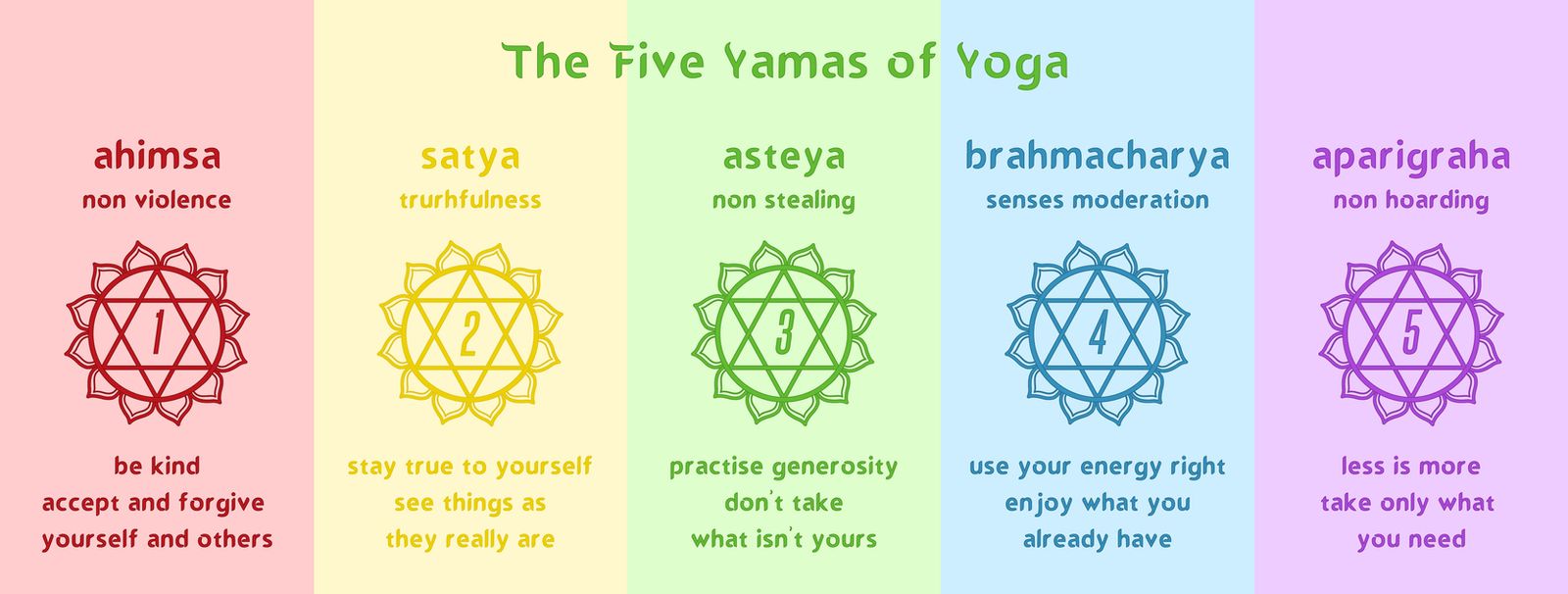
As such, I’d overlooked many of the valuable teachings of yoga, some outlined in Patanjali’s Yoga Sutras. These teachings seem particularly relevant in preventing injury. Ahimsa, or non-violence, includes practising non-violence to oneself. And Satya also comes to mind - to be truthful to ourselves, recognising and accepting our current state of being without pretence or delusion. The principles of Brahmacharya and Aparigraha encourage us to practise moderation and avoid greed (including our desire to accumulate poses and achievement).
I wonder if I had been more present and embodied in these yogic principles as I proceeded - would I have been able to prevent my injuries?
“Listen to Your Body”
If you’ve ever had your own yoga hurts, maybe you’ve already learnt these lessons yourself - to be kind, truthful, moderate, and, yes, that cliché, to listen to your body.
I’ve not loved that phrase much in the past, “Listen to your body.” For me, as a teacher, using it has always felt slightly like a get-out clause to excuse a lazy teaching strategy. It’s always seemed like sensible advice, but something that promptly gets forgotten as soon as the ego takes over the show.
However, I’ve come to value the wisdom of this instruction. It’s taken several injuries and many repetitions to finally hear it. The return of that niggle in the back is reminding me yet again.
Maybe the best thing we can do is to listen, not just to the teacher but ourselves. So we can know when we need to do more and when to do less. No teacher or guide can do that for us.
After resting this week, my back feels better, and I’m excited to return to the mat.
Let’s practise.
Chang Park | NOV 17, 2023
Share this blog post
 OfferingTree