Way of The Dog
Chang Park | MAR 30, 2023
Way of The Dog
Chang Park | MAR 30, 2023
Ah, the most wonderful Downward-Facing Dog posture. Adho Mukha Svanasana. The daddy of all yoga poses.
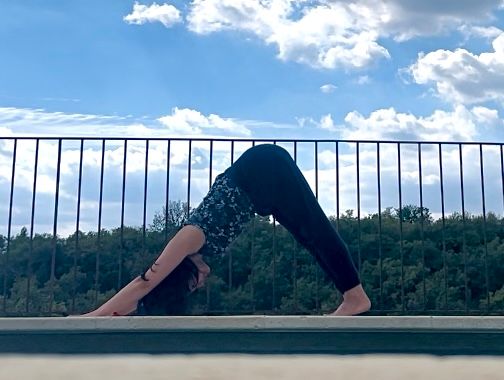
I recall vividly the first time I heard a teacher say in class, “Downward Dog is a rest pose.” I remember giving her a dirty look and thinking, ‘WTF?! I can’t hold this; it’s bloody agony! How can this possibly ever be a rest pose?’ Early in my yoga journey, I’d whine about painful wrists, tight shoulders, aching arms and slippy sweaty hands while panting through my mouth. Suffice it to say, mine wasn’t the healthiest dog in the world.
After over a decade of practice, I can finally relate to this teacher’s words. When better balanced in four limbs and base, stronger now of core and back, and the familiar call of ocean breath flowing between my ears, this most quintessential of yoga poses now feels like home. I’m called back to its familiar shape again and again.
Ways in Dog
Particularly when starting out in yoga, Down Dog can feel anything but the graceful animal it yearns to be. But there are many ways we can find a bit more space, focused action and even ease in this pose.
Here I offer just five modifications that, at some time or other, might help extract a little more juice and joy in Adho Mukha Svanasana.
“I need straight legs.” Not necessarily.
If you find the backs of your legs stiff and tend to round the spine (the first dogs of the day, for example), bending knees helps to get the hips way up and back, giving the spine more length. Sometimes when you have straight legs, you’ll find they’ve just ‘switched off.’ Realise that you need to work the thighs and legs more with bent knees - engagement isn’t optional.
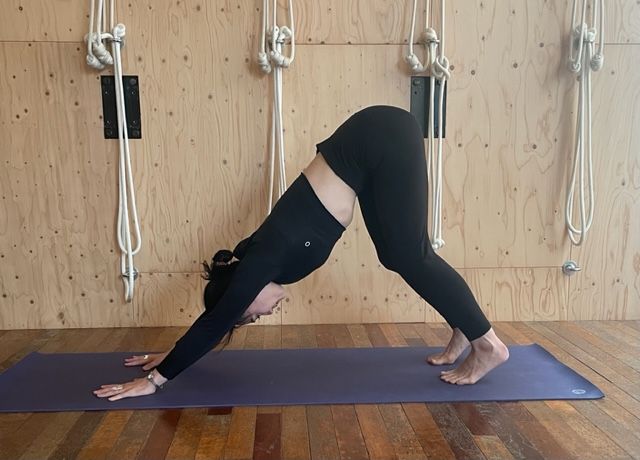
Try: lifting the knees off the floor from all fours and keeping the knees bent; keep that work in your legs as you lift the hips into Down Dog.
“My heels should be on the floor.” Nonsense.
When I see heels grounded with poker-straight legs but a huge curve in the doggy’s spine, I die a little inside (ok, sorry, too dramatic). The longer I practice yoga, the less concerned I am about getting my heels down (unless there’s a specific reason to ground them). Lifting heels takes the pull out of the hamstrings, again allowing the long spine to find space - see a pattern emerging?
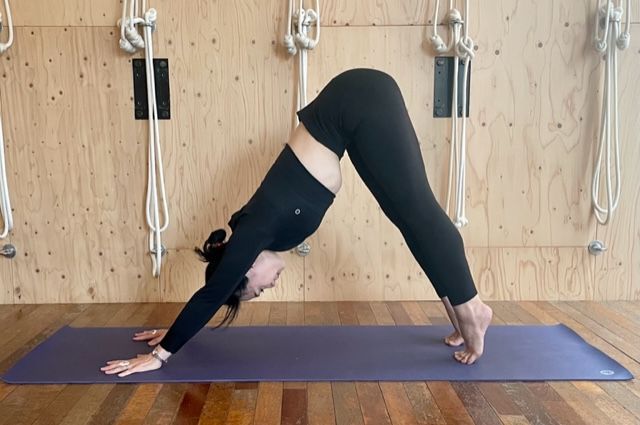
Try: lifting the heels super high (channel ballerina toes) whilst keeping the arms pushing away from the floor and the torso long.
“I feel more stable the shorter my stance.”
Yes, true; a shorter distance between hands and feet gives you a feeling of stability as your muscles need to work less to hold you in that inverted V. However, many of us tend to go too short with our dogs (usually landing the heels in the process - see above and the picture below) - the spine can lose space again. Stance becomes something you step into intuitively with repetition and increased awareness - have you noticed how your dog has ‘grown’ over time?
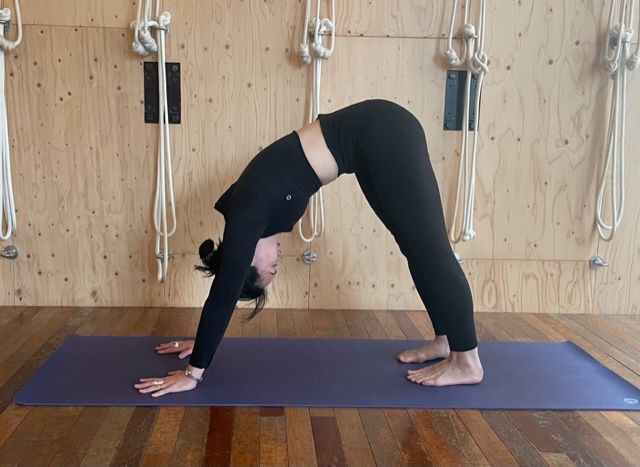
Try: going a bit longer and see what muscles you need to recruit to return your stability.
Just as length is to be experimented with, so with width. Narrow space between two hands or two legs can restrict the freedom to move ‘chest to thigh’ - you might find your spine rounding again. That long spine isn’t creating itself. Too much width, though, and you might collapse - there’s always a sweet spot that needs personal discovery. A suggestion to consider - wider hands for tighter shoulders and wider feet for tighter hamstrings. Please spread your base by opening the palms and feet broad while we’re at it.
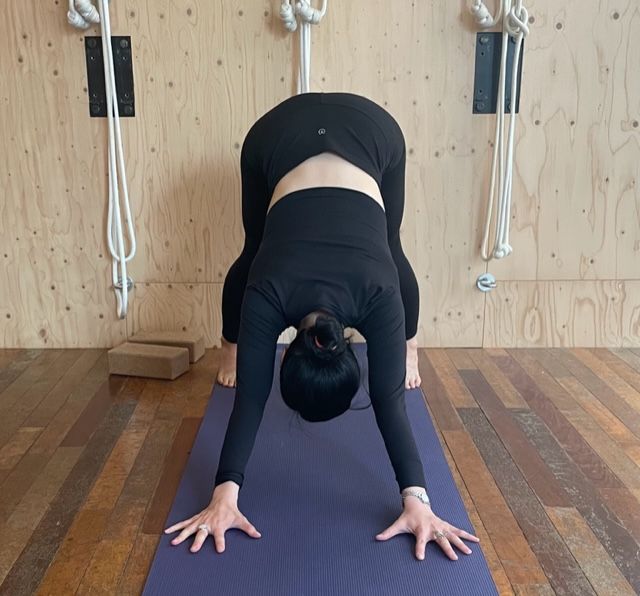
Try: opening the hands a little further apart and/or spinning the palms out a little (two hands on a clock face at 11.05) Or, go even wider and bypass slippy palms by grabbing the edges of the mat (good for sore wrists too).
“I don’t want to use props.” Hmmm, think again if you ever get tired in your arms.
We tend to dump more weight into our arms in Down Dog, making us tire quickly. Generally speaking, our legs are the greater powerhouse versus the upper body.
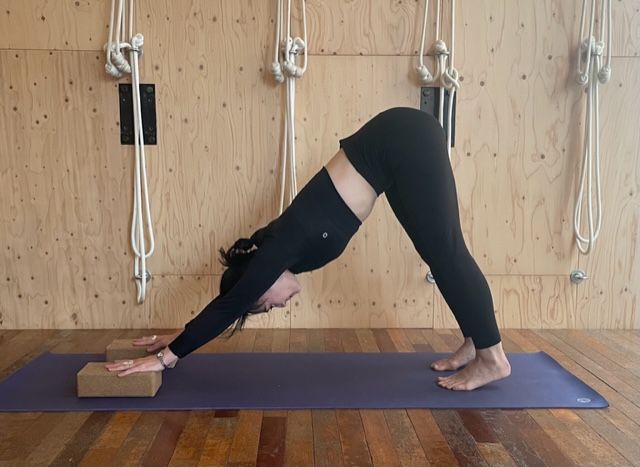
Try: placing your hands on bricks. This added height gives an extra inch or two of arm leverage, driving the direction and weight into the legs, which are encouraged to do more work and readdress the balance. Also quite good for wrist issues.
The Wonders of Dog
Let’s appreciate how much play time and exploration fodder Down Dog has to offer.
It’s a pose that provides the building blocks for so many other poses. It strengthens legs and arms, inner and outer muscles, builds endurance, and opens the shoulders, hamstrings, calves and feet. It teaches us to lengthen the spine with active use of the limbs. Through it, the body learns grounding and ascent, firmness and lightness.
An opportunity to mindfully place the head and neck, this inversion moves us from floor to standing in smooth transitions. And a pause in dog gives a moment to find easeful breath, and maybe, eventually, within that scintillating balance of dynamic actions, stillness.
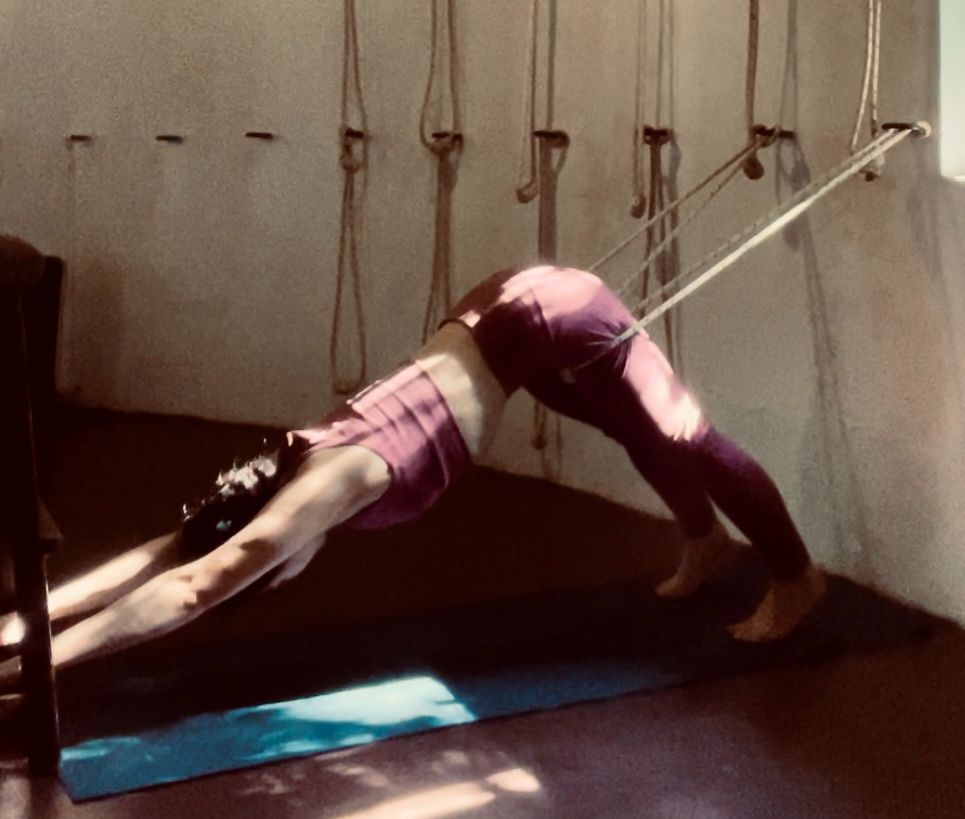
Once the foundations of dog have been laid, explorations can continue. Turning the feet in and out, three-legged dog, narrow dog, open-legged dog, twisted dog. Dog on the forearms, with ropes, flying dog, forehead supported restorative dog. On and on we play.
O Doggy, How I Love You So
It’s always interesting how of those thousands (hundreds of thousands by now, probably!) of dogs, every single one feels slightly different, and tomorrow’s will be different again.
Dog tells me a lot about myself each day. Sometimes a troubled shoulder or twingey hip will make itself known in stark asymmetry. One day, the dog can feel like a crusty old thing; another day, she might feel serenely statuesque - somehow, breath by breath, getting stronger.
This inverted animal has beauty and intelligence and teaches so much. So what does your dog, in all its generosity, show you?
Let’s practise.
Chang Park | MAR 30, 2023
Share this blog post
 OfferingTree