Meditation Goals
Chang Park | OCT 10, 2024
Meditation Goals
Chang Park | OCT 10, 2024
Meditation & Me
The other day, I came across this quote about meditation by James Low that resonated with me so much.
It’s taken me a while to find a way to connect with meditation without feeling frustrated or having high expectations. Seated meditation has eluded me for the longest time. Every time I tried to meditate in the past, I approached it earnestly but struggled to stick with it. Even though I never gave up trying, I’d often wonder why I would find it so hard to sit.
I used to tell myself that it was due to avoidance, lack of priority and discipline, my inherent restlessness and impatience, or a combination of these. With each failure to make meditation a habit, I would feel disappointed and become more identified as someone who couldn’t meditate.

Meditation Is Yoga
Understanding the contexts of meditation and the intentions of ancient meditators helps us understand why we’d want to try this practice in the first place. According to the scholarly interpretations of classical texts like Pantajali’s yoga sutras, meditation is yoga. All the other bits—eight limbs, asana, breathing, and the rest—are simply a means of stilling the mind through meditation.
As per Patanjali, meditation (ergo, yoga) is simultaneously a state, method, and goal. But the goal is what draws us - meditation is a way for a person to breach the mind’s limited perceptions and reach the ultimate state of enlightenment, as the Buddha once did.
Reaching enlightenment is a tall order; the historical context is a teeny bit intimidating. Call me unambitious, but I’m pretty sure I’m unlikely to become a Buddha in my lifetime, and I’m not even sure I want to. I like my little life - I don’t particularly want to go full monk mode, spending my existence meditating my way to nirvana. I’m not sure this is my path.
If I can be honest and say enlightenment isn’t my ultimate intention for meditating, but this is what meditation is really about, why would I even bother meditating?
Meditation for Modern Life
Besides respecting meditation’s origins, which could lead us to radical Liberation, many of us meditate for other, slightly more attainable purposes in modern life. People use it to experience alternate states of consciousness or, more commonly, to cultivate ways of being and working with our minds, all of which can also be liberating (with a small l).
Meditation research has uncovered the remarkable effects of this practice. In studies of long-term meditators, changes in brain circuitry, chemistry and even volume suggest ways in which practices can be helpful for the brain in functions such as emotional regulation, memory, focus, and creativity.
Meditation is popular and thriving, and for good reason. I love the promise of healthy outcomes, and in the age of achievement, performance and wellness, so does everyone else.

Meditation (Non) Goals
However, both stances—meditating to know the true nature of the mind and to become a Buddha and meditating to heal or improve the mind for wellness, health, and performance—have yet to help me maintain consistency in seated meditation.
There have been some small but significant shifts in how I approach meditation, though—new meditation goals, if you will—which have given small breakthroughs. I hope some of these insights are interesting and helpful if, like me, you’ve struggled but are still called to explore...
🪷 Losing the Goal
Given so many scintillating promises of meditation, I know it’s tough to properly release any expectation from it. However challenging it is, practising from a position of non-attachment has changed my relationship with meditation for the better. To see it as more of a process, not a goal.
🪷 Losing Control
An obsession with ‘quietening the mind’ can lead us to equate an inability to control a busy mind with failure. Accepting that thoughts need only be observed, not suppressed, is good enough. Whether the mind is turbulent or still, happy or sad, so long as you notice, this is meditation.
🪷 Losing Time
I’ve come to believe that sitting for twenty minutes isn’t the only valid way to meditate. Meditating on an arising emotion, a sensation, a taste, a big toe, or a breath cycle is still a kind of meditation. Pause and presence may be the only things you need to meditate. Big things happen in small moments.
🪷 Losing Ego
Meditation can become a badge of honour, demonstrating how disciplined or resilient you can be. Just look up Extreme sitting or Raw-dogging to see how a sitting practice can morph into a competitive sport with yourself and others. What are we trying to prove?
Despite my struggles, I haven’t given up on the idea of long, seated meditations. In fact, I think mini-mediative experiences make me more curious than ever to experience the radical awakenings or clarity that others have reported. Vipassana meditation is still on my bucket list! (Here I go, grabbing for goals again - meditation goals!! 😬)
But for this current season, that isn’t yet my karma with this practice. I appear to be in a season of softness. Letting my meditations just be feels magical. In any way they arise and fall, planned or unplanned, clean or messy - that allowing feels like trusting consciousness to unfold as it will.
I can’t say I’m a mediator.
Instead, I find myself meditating sometimes.
Doors To Meditation
I remember a piece of related advice that helped me further shift my perception of this practice and find contentment in each moment of searching. That was the assertion that when someone believes they can’t meditate, like many beliefs, it’s not necessarily true: anyone can meditate if they wish, but they might need a different door to enter from.
For years, I thought seated meditation was the only way. But I realised at some point that I might have already and unknowingly found another small portal - an unconventional way of practising and teaching meditation…Restorative Yoga.
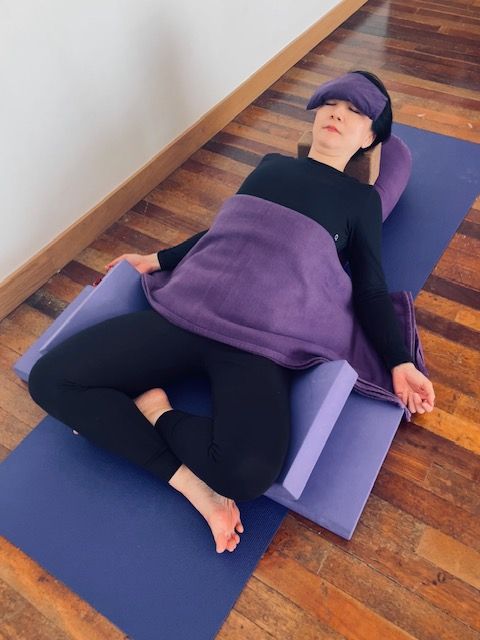
Restorative yoga helps me be still in a way I didn’t think was possible for a restless little beast. It is one way I manage to figuratively ‘sit’ and stay. Setting up the body in specific postures and working with the movables—the body and breath—feels like uncovering a secret pathway to meditation.
Whatever you end up experiencing in a Restorative practice, without a goal or too much agenda, here’s an example of a gift we rarely give ourselves (thank you, James Low): Time To Be Present With How You Are.
Simply meeting yourself in presence, I believe, is a chance to meditate.
You may even find yourself in a state, a method and a goal all at once. This is yoga.
Let’s practise.
Chang Park | OCT 10, 2024
Share this blog post
 OfferingTree