I've Got Your Back
Chang Park | JUN 27, 2024
I've Got Your Back
Chang Park | JUN 27, 2024

Back to Back
After teaching last Saturday, I headed to attend a musculoskeletal symposium for the spine for clinicians and physiotherapists. With eleven neurosurgeons in attendance, the discussions leaned towards surgical topics such as endoscopic discectomy, nerve ablation, and spinal injections. However, what interested me the most were the perspectives on mechanical or non-specific back pain, one of the most common problems I encounter in my clinic.
Statistics show that 65-80% of adults will experience back pain at some point, and one in five will have an ongoing or recurrent problem. Lower back pain is a major cause of disability worldwide and a leading cause of work absence.
Conservative Management
The problem with non-specific back pain is that multiple factors are at play, and typically, there's no single root cause that surgeons can fix easily by applying the knife. Back pain thrives on a bed of interacting contributors like poor posture, obesity, psychosocial issues, and a sedentary lifestyle.
I really like this excellent video (created 10 years ago and still brilliant!) by Dr Mike Evans that explains back pain so nicely; it’s worth watching if you’ve ever had an episode or two of significant back pain: Low Back Pain
As evidenced at the Saturday symposium, the surgeons seemed to understand their role in managing this extremely common problem — that is, they rarely have one. Every surgeon emphasised prevention, rehab, movement, and conservative management (a term used in medicine to describe interventions that avoid invasive measures like surgery).
Guess which self-management practices surgeons most often recommend for healthy backs?
Yoga and Pilates, of course!
Fillet vs Sirloin
I captured a slide from a presentation by Dr. Ajai Seth, a Consultant in Sports & Exercise Medicine, at the symposium.
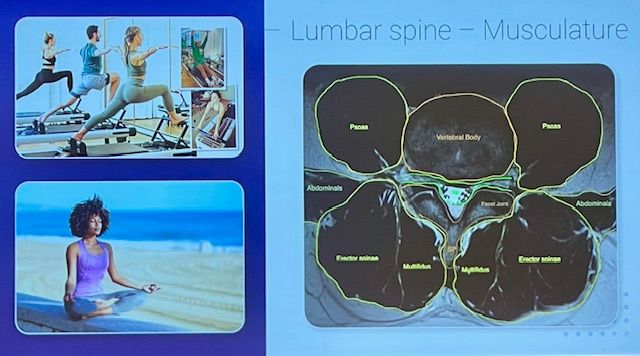
The MRI image provides a cross-sectional view of the musculature around the lower spine. Dr. Seth uses this image to help patients visualise the muscles and to emphasise the importance of having more lean muscle (appearing dark black on MRI) and less fat (appearing white on MRI).
He used the analogy of acquiring more fillet steak versus sirloin. While sirloin might be delicious for eating, it is much less desirable as scaffolding!
The muscles located near the vertebral column, such as the multifidi and erector spinae, are not under conscious control like the biceps or hamstrings, but they are crucial for supporting the spine. These relatively small but essential muscles are engaged when maintaining an upright posture and during slow, controlled stabilising movements in yoga and Pilates.
As much as I like the fillet vs. sirloin analogy, yoga’s effectiveness for alleviating and preventing back pain is more nuanced than simply building a ton of strong, lean muscle. Yoga has been recognised for its inclusion in the UK guidance for managing lower back pain since 2017, and rightly so, since it brings a lot to the table.
I see yoga as a comprehensive aid, similar to using an MDT (Multi-disciplinary Team) in medicine, where different members work together for better outcomes.
Let’s have a look at our mini MDT…
Yoga MDT
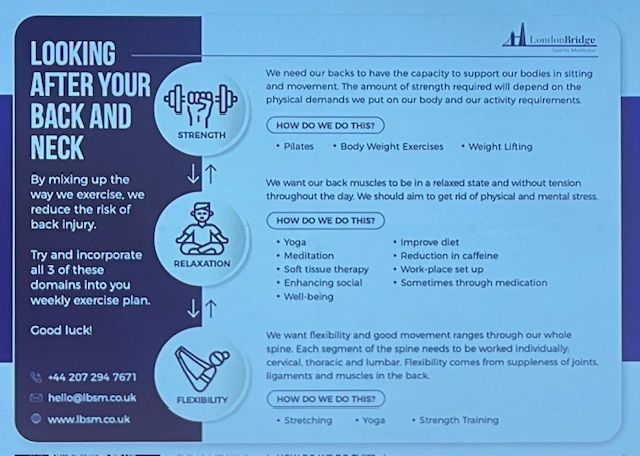
Release. Muscles can be weak but also overdeveloped and tight. Yoga deals with constructive balance, building muscle strength and quality as well as the requisite flexibility and elasticity. With stretching and relaxing tension, we learn to release muscles—as important as contracting them.
Discs. I like to envisage moving the spine akin to ‘oiling’ the hip bones in their sockets. This fluid movement benefits other important structures intricately related to the spine. The fibrous discs that cushion between the vertebral bones, prone to drying out and ‘slipping’ with age and inactivity, remain plump and hydrated through biomechanical action, enabling them to function as effective shock absorbers.
Bone Health. Vertebral bones can lose height and density as we age and may even fracture due to conditions like osteopenia or osteoporosis. The right types of weight-bearing exercises provide the necessary loads and help to prevent further bone loss.
Nervous System & Pain Perception. Yoga offers the benefit of regulating the nervous system. By deliberately relaxing, breathing well and reprocessing our stress responses, we influence one of the most significant risk factors for developing - and sustaining - chronic back pain.
Mind and Attitude. This mind-body practice promotes a positive relationship with movement, associated with capability rather than infirmity. It encourages an understanding that movement is vital even with a history of pain or injury and should be embraced rather than feared.
I probably haven’t mentioned all the team members, but you get the picture.
Yoga’s Got Your Back
I find yoga is still sometimes viewed with trepidation by those who’ve ever suffered from bad backs. All those shapes can look intimidating and sometimes extreme, but they don’t have to be. Yoga can be gentle or strong, adaptable, and specifically tailored before, after and even during an episode of back pain.
I’d love to recommend an excellent evidence-based Yoga program specially tailored for backs, particularly if you know of anybody with such trepidation and might benefit from an introduction to what yoga can do. For anyone needing additional support for backs, please check it out and share: yoga for backs.
(No conflicts of interest; I think it’s genuinely great!)
For the rest of us… you know it already.
Yoga has your back.
Let’s practise.
Chang Park | JUN 27, 2024
Share this blog post
 OfferingTree