Every Mind Matters
Chang Park | MAY 11, 2023
Every Mind Matters
Chang Park | MAY 11, 2023

What comes to you when you think about your mental health? The state of mine seems to change constantly - sometimes predictable, sometimes not. The word coming up for me right now is 'overthinking'. Overthinking, rumination, assuming and catastrophising - my brain is expertly capable of machinations intended to protect me from harm. But these same thoughts also drive me up the wall, waste a hell of a lot of time and cause distress, mental and physical. These are some of the symptoms of anxiety - the focus of this year's Mental Health Awareness Week (15th to 22nd May).
Yoga is one of the things I do that helps me feel calmer and more relaxed, reduces overthinking even for short periods, and helps me gain control of my emotions and responses. Maybe some of you can relate. Apart from the clear physiological processes that occur when we move the body and breathe - movement is medicine, after all - my practice lends me a time out from my restless mind. Afterwards, I often experience a wider perspective outside my thoughts, which brings great comfort.
This week, I offer an interview I did for Yogamatters blogs - a conversation with Consultant NHS Psychiatrist and retired yoga teacher Dr Charlotte Marriott. Charlotte is a Lifestyle Medicine Physician and is committed to inspiring and empowering patients to make small changes to their lifestyles to improve their physical and mental health and well-being. Charlotte and I graduated in the same year from UCL medical school almost twenty years ago, so it was an extra special pleasure to catch up with her.
Tell us about how you got into Psychiatry.
I always had an inkling that Psychiatry would be where I would be heading. At medical school, I found Neuroscience fascinating - learning about emotion and behaviour, learning and memory and how the brain works.
And people’s stories have always interested me. In Psychiatry, you have time to find out about patients, their life stories, and the inner workings of their minds and experiences; it’s a very holistic speciality. We help people with a whole range of things they need in their life; we work in a very multidisciplinary way.
You are known as The Lifestyle Psychiatrist. What made you move in this direction?
I have always had an interest in health and maintaining health. In medical training, there is such a focus on illness and disease but not necessarily on helping people improve their health. I often felt like we would do a ‘sticking plaster method’ - patch people up and send them on but not really help with the whole range of whatever else was going on for them. I came across Lifestyle Medicine in 2018, and it just made so much sense to me - reducing the burden of chronic disease, morbidity and comorbidity, polypharmacy, helping people lead healthier lives, and even reversing chronic diseases like Diabetes through lifestyle.
Lifestyle Psychiatry is a growing speciality - it’s a term coined by Douglas Noordsy - he brought together all the evidence about how lifestyle can improve mental health. The pillars of Lifestyle Medicine are nutrition, physical activity, sleep, substance reduction, positive psychology and stress reduction. The research is vast and ever-growing, particularly with researchers like Brendon Stubbs and Simon Rosenbaum, who do a lot of research into physical activity, and in Australia with Prof Felice Jacka and her work on the SMILES trial looking at nutritional Psychiatry. I wanted to incorporate this into my NHS work, train and educate other clinicians, and have conversations with our patients about what they eat, how they sleep, what movement they do, and take an even more holistic view of mental health.
What’s the reception like from colleagues and other psychiatrists to the Lifestyle Psychiatry approach?
I’ve had good feedback and reception from colleagues. People are fascinated - if you present the evidence, people are interested, and you can’t argue with the science.
Some of the scepticism I’ve had is around the idea that we all know we need to eat better and move more, so what’s the big news here? But the point is that knowing it isn’t enough; you need to actually do it. Understanding behaviour change, evaluating someone’s confidence to change, their motivation to change etc., to help them identify what is possible for them is an integral part of helping a patient make those changes.
How about the reception from patients?
I sort of weave it into our regular consultations. Part of why I’m so keen on it in what I do in early intervention psychosis is because my patients with Schizophrenia, for example, have a reduced life expectancy - they die 15-20 years younger than the general population. A lot of that is to do with cardiometabolic syndrome, and then we contribute to that risk with the medications we prescribe, and so to mitigate that, Lifestyle Medicine has a role to play.
I had one guy taking olanzapine (an antipsychotic that causes a lot of weight gain) who hated exercise. "Oh, I hate walking, absolutely hate it". So I asked him, "Could you do 5 minutes?" Yes, well, after a short while, he was walking for an hour a day, built up and started to notice the benefits. His weight stayed the same, but he gained confidence, saw people when he left the house and improved his quality of life in ways that were not necessarily related to physical health but brought other benefits.
Tell us about your yoga journey.
I went to my first yoga class at the University student union on a Monday lunchtime. I couldn’t do any of it (!), but the feeling I had after the class was amazing. I felt so relaxed, and so I kept going back.
Over the years, my practice has waxed and waned; there’ve been times when I’ve been very dedicated and times when life gets in the way. After I had my second baby, I picked it up again in earnest. By then, I had two small children, I was working and had no time for myself. I needed something that was just mine, and I started a dedicated daily practice then, and it really benefited me physically, emotionally, mentally, all of it. I got strong again, fitter than I’d ever been before but also calm, more able to manage the day-to-day stressors of being a working mum, and more able to be present for my family. I also really enjoyed the meditative aspect and stillness of practice, finding that peace and clarity of mind, and that’s what I really loved about it.
I got into Ashtanga yoga for a number of years, until the Pattabhi Jois sexual abuse scandal came out. That made me reevaluate my whole relationship with Ashtanga yoga, and I stopped practising it for a while. In a way, it was helpful because Ashtanga can be quite dogmatic, quite rigid and ‘this is what I do’. Stopping helped me be less attached and freed up my yoga practice quite a bit.
I taught for a few years but stopped just before the pandemic. I was exhausted doing too many things. One of the drawbacks of teaching a group class was that the spiritual element was missing for me - it felt more like a group exercise class. I enjoyed one to one more. But I was doing too many things and knew something had to give.
What does your practice look like now?
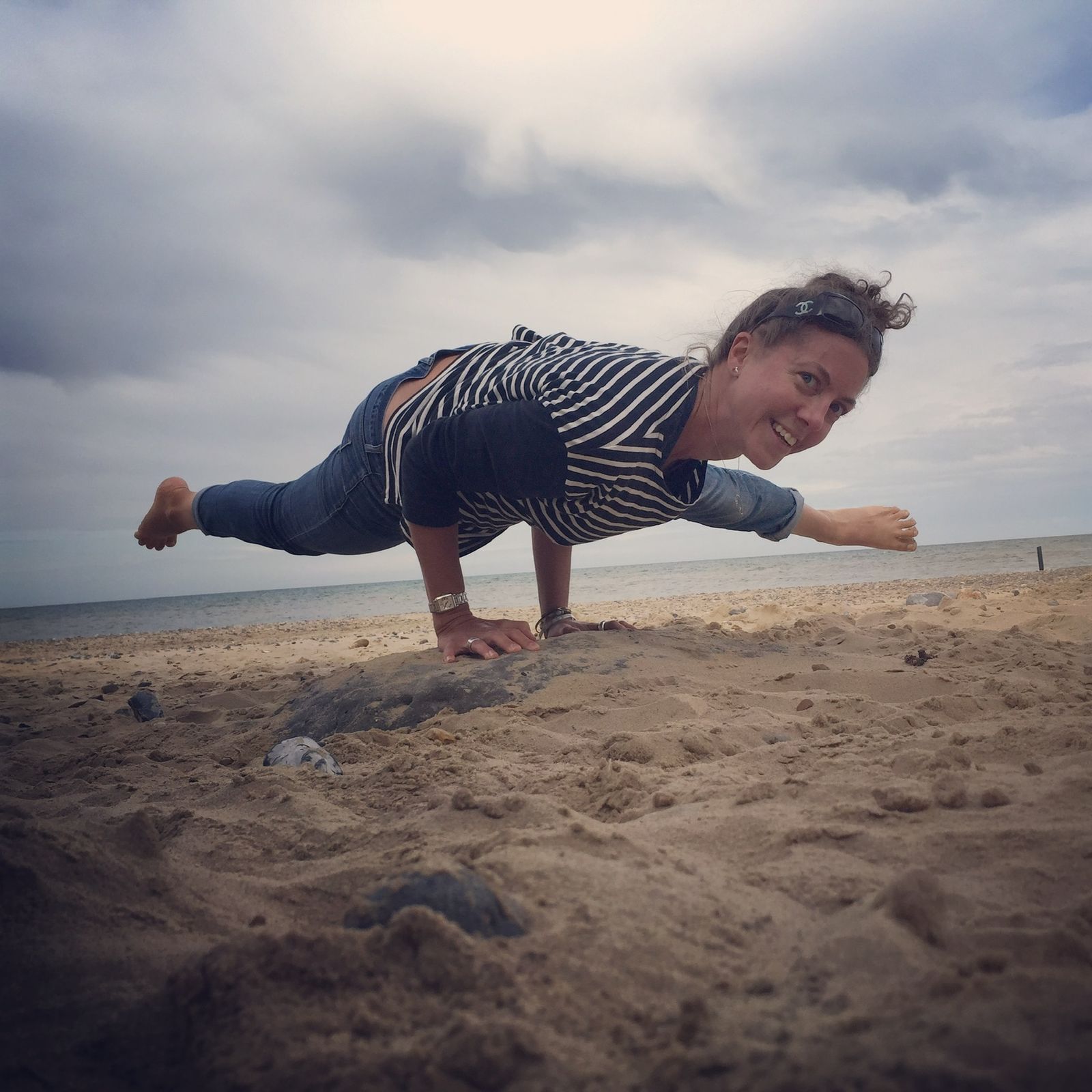
I’m practising in a much less rigid way. I’m less attached to it, how well I do poses, whether I can do a pose or not. I’m much more interested in the benefits it has for me mentally and emotionally than how my practice looks. I think it helped not having a teacher during Covid because no one was looking at my practice, so it was much less about trying to achieve and more about how it made me feel. It’s much more free-form these days; yesterday, I did Primary Series standing postures and then Savasana. I still like the Ashtanga method; the sequence makes sense to me. Doing that sequence, I’m very quickly in a meditative state. I’ll do a bit of yin and restorative, and sometimes I’ll just do Child's pose for ten minutes.
You mentioned the lack of a spiritual element to yoga while teaching. Is yoga a spiritual practice for you?
I’ve had some - I don't know what you would call them - not necessarily epiphanies, but you know, when you’re in Savasana, I’ve had some incredible realisations, and things have shifted in my mind. I can’t see it any other way other than a spiritual undertaking. Also, I’ve tried Pilates and enjoyed it, but it lacked something for me, and what it was was the spiritual element - it didn’t fulfil me, and I didn’t connect with it in the same way. Yoga is definitely more than a physical practice.
Do you recommend yoga to patients? What’s been your experience with that?
I do recommend it to patients. I don’t tend to suggest the spiritual side because I know that many people have their own religious or spiritual beliefs, and I don't want to offend anybody. I’ve had people say, "I’m a Christian, I can’t do yoga", so sometimes it’s helpful not to overstate the spiritual or to say that you can do it whatever your religious background, that it’s not a religious doctrine.
I have a few examples I can recall. About ten years ago, a patient was admitted to a psychiatric ward I was working on with an anxiety disorder. He was on a lot of medication (two antidepressants, an antipsychotic, and a sedative), and he was still super anxious and wanted
more medication. I noticed he was hyperventilating a lot. I started to talk about how he could learn to breathe to help his anxiety, and to begin with, he was so angry with me about this suggestion. I explained the physiology of breathing, and he eventually tried it. Within a couple of weeks, he was reducing his medication. That gave me the confidence to continue to talk to people about these things.
And a few years ago, I had another chap on a few medications. He mentioned that he had started going to a meditation group, which he found helpful for his anxiety. So I said, ‘Well, if you like meditation, have you ever tried yoga?’ So I suggested some beginner's videos online; three months later, he returned and said, ‘Doc, that yoga that you recommended? I feel fantastic; I’ve stopped all my medication and want to be discharged; I feel great.’ So I’ve had a couple of real success stories.
You mentioned breathing for anxiety. Could you speak of the mechanisms by which yoga helps - what do you think it is?
I think it’s multi-faceted; part of it is just pausing during your day. It gives us a window of opportunity to have a bit of stillness in the mind. Stillness, quiet, breathing, and to stop thinking so much. To learn that we are separate from our thoughts and they are not us, we don’t always need to pay attention to them. This can be particularly helpful for people with anxiety disorders, where people get so caught up in their thoughts. Think of yogas-citta-vrtti-nirodaha, finding that quieting of your mind. I think it takes practice to get to that point.
I think breathing is fundamental to yoga practice. There’s so much research about the benefits of deep, slow breathing on our brain waves, our default mode network, how our brain is working, and our parasympathetic nervous system.
I did a presentation at work about the research evidence behind yoga, and again the response to that was really good. There are a lot of studies looking at the benefits, mostly around meditation, but I see yoga as a meditative practice. I think we can extrapolate the benefits for improving anxiety, depression, and even Schizophrenia. For example, a study about the impact of yoga on Schizophrenia showed that yoga improved the ‘negative’ symptoms such as apathy and amotivation and also improved Quality of Life scores.
Is there anyone that yoga wouldn’t be suitable for?
We have to be mindful of trauma. I know that many yoga practices are not helpful for those who have experienced trauma. For example, some people don’t like to close their eyes; they find concentrating on their breath or turning their attention to their body can be triggering. So we need to be mindful of those things. I know some yoga is deliberately therapeutic, using very slow, cautious ways of getting people to get into their bodies again.
I don’t tell all my patients that they should go and do yoga. I get a sense of when it could be helpful for them or what aspects could benefit them. The breathing side of things is fundamental for people with anxiety disorder, so I tend to teach that to everyone with anxiety. But I don’t always call it yoga.
Do you turn to any particular resources, particularly for people with anxiety?
I like to recommend things that are free and readily available. The thing I recommend the most is probably Eddie Stern’s The Breathing App. You can make it work for you, change timings, and make it visual or auditory. And then, if people want to start physical yoga, Yoga with Adriene online is free and accessible.
A big question, but what do you think are the most significant challenges for the mental health of the nation as a whole?
One big thing is disconnection. I think we’re all not connected to each other or the natural world around us. We’re not even connected to ourselves most of the time. I think that’s a massive problem with how we live in the 21st century. Everybody lives individually, going about their individual lives and being too busy.
I think technology has a lot of pros and cons and has a lot to answer for too. It’s so easy to use technology as escapism - play video games, watch TV, social media. All of that is disconnecting you further from your life and other people, and I don't think that’s very helpful.
I think there are big social issues - poverty, racism, sexism, drug abuse, trauma, and adverse childhood experiences are a massive problem and have a huge impact on adult mental health. Issues with education, funding, poor quality housing and food where our biological needs are unmet. We are not living in tune with our biology as human beings; we’ve gone so far down the route of progress that we are now no longer in touch with our animal nature.
I see so many young people who are struggling, they are kind of lost in their lives - struggling to find meaning and purpose - just disaffected. Not necessarily depressed but suffering nonetheless. And Covid has had a huge impact on the nation’s mental health. Research shows that chronic loneliness is as bad for you as smoking fifteen cigarettes a day. People are struggling in so many ways, which will obviously impact on mental health.
Do you turn to anything for your well-being apart from yoga?
Being outside in nature is fundamental for my health and well-being, and the research evidence says it is for all of us. We need nature for our survival, and it’s a biological necessity for us to be in nature.
One of the other things I found helpful is a gratitude journal which I started as a kind of experiment for a week. But I started and was never able to stop - it makes you remember the lovely things that happened, even on a difficult day. You can still pick out a few nice things, and they are always the simple things like the sun was shining, or I had a really nice coffee. Small small things that bring you joy every day. And it helps you to notice them - the more you do it the more you look out for the little moments of joy.
Dr Charlotte’s Recommendations:
Books:
One Simple Thing, Eddie Stern
Breath, The New Science of a Lost Art, James Nestor
The Inflamed Mind, Edward Bullmore
Brain Changer, Felice Jacka
The Psychobiotic Revolution, Anderson, Cryan and Dinan
The Body Keeps the Score, Bessel van Der Kolk
Losing Eden, Why Our Minds Need the Wild, Lucy Jones
Apps:
The Breathing App
Podcasts:
Feel Better, Live More
Huberman Lab
The Ashtanga Dispatch
Find Charlotte:
Instagram: @thelifestylepsychiatrist
Website: www.thelifestylepsychiatrist.co.uk
Chang Park | MAY 11, 2023
Share this blog post
 OfferingTree